
5 Pentecost
Save yourselves from this untoward generation

The next annual Sabbath after the feast of Unleavened Bread is called Pentecost or the Feast of Weeks. The name Pentecost is derived from the Greek pentēkostē, meaning fiftieth, because the day is calculated by counting fifty days from the weekly Sabbath that falls within the Feast of Unleavened Bread. This calculation is also expressed as seven weeks plus one day; hence, its name: Feast of Weeks. The third name for this Sabbath is Firstfruits.
And ye shall count unto you from the morrow after the sabbath, from the day that ye brought the sheaf of the wave offering; seven sabbaths shall be complete:
Even unto the morrow after the seventh sabbath shall ye number fifty days; and ye shall offer a new meat offering unto the LORD.
Ye shall bring out of your habitations two wave loaves of two tenth deals: they shall be of fine flour; they shall be baken with leaven; they are the firstfruits unto the LORD. (Lev 23:15-17)
Just as the Feast of Unleavened Bread was a continuation from the Passover, Pentecost is linked to the Feast of Unleavened Bread, both by its calculation - seven weeks after the sheaf of grain symbolising Christ, the first-born from the dead, was waved by the priest, and by the use, once again, of the term firstfruits; a description shared with Christ.
But now is Christ risen from the dead, and become the firstfruits of them that slept.
For since by man came death, by man came also the resurrection of the dead.
For as in Adam all die, even so in Christ shall all be made alive.
But every man in his own order: Christ the firstfruits; afterward they that are Christ’s at his coming.
(1 Cor 15:20-23)
A Parallel in the Jubilee
We once again have seven weeks being counted, seven being the biblical number for perfect completion, but we also have fifty days, and fifty is also a fascinating biblical number. It leads us to the Jubilee.
In God’s instructions to Israel regarding their conduct in the promised land, provision was made to give rest to agricultural land every seventh year, the so-called sabbath-of-the-land. After seven sabbaths, the year following was defined as the jubilee; the fiftieth year. This, too, is set aside for a holy purpose:
And ye shall hallow the fiftieth year, and proclaim liberty throughout all the land unto all the inhabitants thereof: it shall be a jubilee unto you; and ye shall return every man unto his possession, and ye shall return every man unto his family.
A jubilee shall that fiftieth year be unto you: ye shall not sow, neither reap that which groweth of itself in it, nor gather the grapes in it of thy vine undressed.
For it is the jubilee; it shall be holy unto you: ye shall eat the increase thereof out of the field.
In the year of this jubilee ye shall return every man unto his possession.
(Lev 25:10-13)
This is a direct parallel to Pentecost. In both Pentecost and the Jubilee, seven sabbaths pass, and one further time interval brings us to fifty. That fiftieth span, being a further Sabbath, is a period of time reserved for holy use. The two mirror one another precisely, and so what we learn from the Jubilee applies also to Pentecost.
Pentecost consequently represents liberty, and a return to our original possessions, being freed of debts, obligations, and errors that have accumulated and which hold us in bondage. While the Jubilee addresses directly such things as land ownership and the forgiveness of all monetary debts, we are here discussing the redemption of mankind. So the parallel extends to a return to our former relationship with God and the forgiveness of our spiritual debts (our sins). The liberty anticipated is the removal of the shackles of sin; the family we are returning to is that of our heavenly Father.
The New Testament Fulfilment
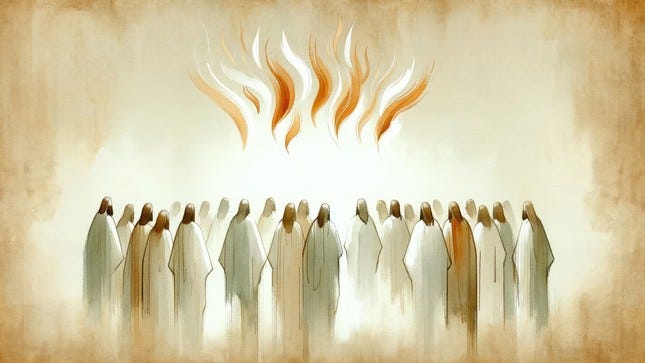
The primary fulfilment of this symbolic day occurred after Jesus crucifixion, resurrection, and ascension. Christ rose on the weekly Sabbath during the Feast of Unleavened Bread, and the events of Pentecost occurred fifty days later. They are described in the second chapter of the book of Acts:
And when the day of Pentecost was fully come, they were all with one accord in one place.
And suddenly there came a sound from heaven as of a rushing mighty wind, and it filled all the house where they were sitting.
And there appeared unto them cloven tongues like as of fire, and it sat upon each of them.
And they were all filled with the Holy Ghost, and began to speak with other tongues, as the Spirit gave them utterance.
And there were dwelling at Jerusalem Jews, devout men, out of every nation under heaven.
Now when this was noised abroad, the multitude came together, and were confounded, because that every man heard them speak in his own language. (Acts 2:1-6)
Thus, the spirit of God, hitherto accessible only to those few prophets selected by God to convey His message to His nation, was poured out onto the servants of God. It transformed them in ability, in courage, and in discernment. Peter, who on the night of the crucifixion had three times denied Christ, was no longer afraid. He stood up and spoke boldly to the Israelites around him, saying:
Ye men of Israel, hear these words; Jesus of Nazareth, a man approved of God among you by miracles and wonders and signs, which God did by him in the midst of you, as ye yourselves also know:
Him, being delivered by the determinate counsel and foreknowledge of God, ye have taken, and by wicked hands have crucified and slain:
Whom God hath raised up, having loosed the pains of death: because it was not possible that he should be holden of it. (Acts 2:22-24)
His timidity gone, Peter lets them have it. He says:
Jesus, a man approved of God
A worker of signs and miracles
As you yourselves know
Taken by wicked hands and slain
God has raised from the grave
Just as in the Jubilee, here, with the Holy Spirit, the servants of God find freedom; freedom from fear in the case of Peter.
Now the Lord is that Spirit: and where the Spirit of the Lord is, there is liberty. (2 Cor 3:17)
Freedom in Christ means freedom from whatsoever holds each of us in subjugation and is thus as individual as we are.
The Ten Commandments
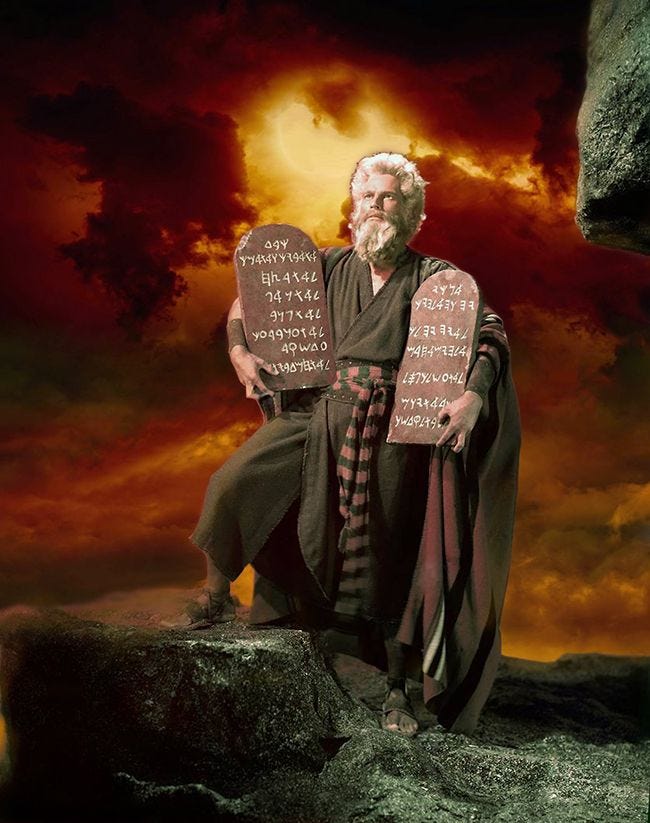
As we have seen in the Passover and Feast of Unleavened Bread, there are striking parallels between the journey of the nation of Israel out of Egypt and to the Promised Land and the journey of the Christian out of bondage to sin and towards service in God’s Kingdom. So what, we must enquire, was happening on Pentecost during the exodus from Egypt?
The precise dates for this next portion are not simply stated in scripture, but a strong indication can nevertheless be obtained. Taking the weekly Sabbath within the Feast of Unleavened Bread as falling on the 17th of the first month during the exodus, as it did during the crucifixion, and adding 50 days, we have Pentecost on the 67th day of the year. The new moon marking the first day of the third month will generally fall on the 60th day of the year (2 months x 29.5 days average lunar cycle, plus 1 day, the first of the third month). With this proviso, Pentecost would land on the 8th day of the third month of the year during the exodus. We can therefore check the biblical record for information as to what was happening during the first eight days of the third month when the Israelites left Egypt.
In the third month, when the children of Israel were gone forth out of the land of Egypt, the same day came they into the wilderness of Sinai. (Exo 19:1)
After this, the people camped at the mountain, and Moses went up to God. God gave Moses his offer to the whole nation of Israel
Now therefore, if ye will obey my voice indeed, and keep my covenant, then ye shall be a peculiar treasure unto me above all people: for all the earth is mine:
And ye shall be unto me a kingdom of priests, and an holy nation. (Exo 19: 5-6)
It is notable that, here too, God seeks the consent of the people, even after all he has done to save them from slavery and oppression, and from the vengeance of Pharaoh and his army. The people give their consent:
And all the people answered together, and said, All that the LORD hath spoken we will do. And Moses returned the words of the people unto the LORD. (Exo 19:8)
So Moses returned once again up onto the mountain, conveying the answer from the Israelites.
And the LORD said unto Moses, Lo, I come unto thee in a thick cloud, that the people may hear when I speak with thee, and believe thee for ever. And Moses told the words of the people unto the LORD.
And the LORD said unto Moses, Go unto the people, and sanctify them to day and to morrow, and let them wash their clothes,
And be ready against the third day: for the third day the LORD will come down in the sight of all the people upon mount Sinai. (Exo 19:9-11)
And Moses and the people followed these instructions. and the people prepared for two days, then, on the following day, the presence of the Lord came down to the mountain:
And it came to pass on the third day in the morning, that there were thunders and lightnings, and a thick cloud upon the mount, and the voice of the trumpet exceeding loud; so that all the people that was in the camp trembled.
And Moses brought forth the people out of the camp to meet with God; and they stood at the nether part of the mount. (Exo19:16-17)
Just as tongues of fire descended upon the believers on the day of Pentecost following Christ’s ascension, on this day, during the Exodus, the presence of God was likewise indicated by fire.
And mount Sinai was altogether on a smoke, because the LORD descended upon it in fire: and the smoke thereof ascended as the smoke of a furnace, and the whole mount quaked greatly. (Exo 19:18)
Then the Lord made his entry onto the mountaintop.
And the LORD came down upon mount Sinai, on the top of the mount: and the LORD called Moses up to the top of the mount; and Moses went up. (Exo 19:20)
God warned Moses not to let the people come up the mountain for reasons of ‘health and safety’:
And the LORD said unto him, Away, get thee down, and thou shalt come up, thou, and Aaron with thee: but let not the priests and the people break through to come up unto the LORD, lest he break forth upon them.
So Moses went down unto the people, and spake unto them. (Exo 19:24-25)
I would briefly point out that there are two Lords (two Yehovahs or two Yahwehs) in that sentence; one is referring to the other. In both cases, the word used is the proper name of the deity, the God of Israel. This is one of several cases where two Gods are mentioned in the Old Testament. One is the Father, and the second became a man and dwelt amongst us, and we know him as Jesus, the Son of Man, the messiah.
So Moses returned to the foot of the mountain once again and prepared the people. They were to hear the voice of God, booming from the mountaintop, declaring his commandments in which they were to live.
And God spake all these words, saying,
I am the LORD thy God, which have brought thee out of the land of Egypt, out of the house of bondage.
Thou shalt have no other gods before me.
Thou shalt not make unto thee any graven image, or any likeness of any thing that is in heaven above, or that is in the earth beneath, or that is in the water under the earth:
Thou shalt not bow down thyself to them, nor serve them: for I the LORD thy God am a jealous God, visiting the iniquity of the fathers upon the children unto the third and fourth generation of them that hate me;
And shewing mercy unto thousands of them that love me, and keep my commandments.
Thou shalt not take the name of the LORD thy God in vain; for the LORD will not hold him guiltless that taketh his name in vain.
Remember the sabbath day, to keep it holy.
Six days shalt thou labour, and do all thy work:
But the seventh day is the sabbath of the LORD thy God: in it thou shalt not do any work, thou, nor thy son, nor thy daughter, thy manservant, nor thy maidservant, nor thy cattle, nor thy stranger that is within thy gates:
For in six days the LORD made heaven and earth, the sea, and all that in them is, and rested the seventh day: wherefore the LORD blessed the sabbath day, and hallowed it.
Honour thy father and thy mother: that thy days may be long upon the land which the LORD thy God giveth thee.
Thou shalt not kill.
Thou shalt not commit adultery.
Thou shalt not steal.
Thou shalt not bear false witness against thy neighbour.
Thou shalt not covet thy neighbour’s house, thou shalt not covet thy neighbour’s wife, nor his manservant, nor his maidservant, nor his ox, nor his ass, nor any thing that is thy neighbour’s. (Exo 20:1-18)
The reaction of the people to hearing the voice of God, the God they had witnessed saving them in multiple ways in the preceding few months, was to run away:
And all the people saw the thunderings, and the lightnings, and the noise of the trumpet, and the mountain smoking: and when the people saw it, they removed, and stood afar off.
And they said unto Moses, Speak thou with us, and we will hear: but let not God speak with us, lest we die.
And so the rest of the conversation was with Moses alone, and he related God’s instructions to the people. Nevertheless, God made a point of emphasizing, as he started to give these laws to Moses, that the people had heard his voice directly, for themselves, with their own ears.
And the LORD said unto Moses, Thus thou shalt say unto the children of Israel, Ye have seen that I have talked with you from heaven. (Exo 20:23)
In response to their request, the remainder of the law was given by God to Moses for onward transmission to the people. This is described in chapter 24 of Exodus:
And Moses came and told the people all the words of the LORD, and all the judgments: and all the people answered with one voice, and said, All the words which the LORD hath said will we do.
And Moses wrote all the words of the LORD, and rose up early in the morning, and builded an altar under the hill, and twelve pillars, according to the twelve tribes of Israel.
And he sent young men of the children of Israel, which offered burnt offerings, and sacrificed peace offerings of oxen unto the LORD.
And Moses took half of the blood, and put it in basons; and half of the blood he sprinkled on the altar.
And he took the book of the covenant, and read in the audience of the people: and they said, All that the LORD hath said will we do, and be obedient.
And Moses took the blood, and sprinkled it on the people, and said, Behold the blood of the covenant, which the LORD hath made with you concerning all these words. (Exo 24:3-8)
Note how thoroughly consent is established. First, God outlines the proposal; the people agree. Then they hear the ten commandments for themselves, and Moses recounts the whole law to them, and they agree a second time. Finally, Moses commits the law to writing and reads that to them to be sure that the documented version is approved. They agree a third time. There can be no doubt that God seeks willing consent from those who follow him; informed, voluntary, express consent.
So, looking at the timeline, and taking Pentecost to be the eighth day of the third month, we arrive at:
1st day (Sunday) - Israelites arrive at Sinai and make camp.
2nd day (Monday) - Moses goes up and receives God’s offer to the people.
3rd Day (Tuesday) - Moses takes the people’s reply to God, and receives instructions on how the Israelites should prepare
4th day (Wednesday) - First day of preparation
5th day (Thursday) - Second day of preparation
6th day (Friday) - God’s presence descends onto the mountain, he speaks with Moses to warn the Israelites not to come too close.
7th day (Sabbath) - God thunders the ten commandments and is heard by the whole nation. They become frightened and ask Moses to act as a go-between.
8th day (Sunday) - Israel enters into a Covenant with God
This seems to align extremely well and also to parallel precisely the New Testament fulfilment, when the new covenant came into effect for those who believe in Jesus and follow his example. We can therefore conclude that the Old Covenant and the New were both inaugurated on Pentecost.
The Old and New Covenants
What then is the difference between the Old and New Covenants? The prophet Jeremiah laid this out with stunning clarity around 600 years before Christ was born. He wrote:
Behold, the days come, saith the LORD, that I will make a new covenant with the house of Israel, and with the house of Judah:
Not according to the covenant that I made with their fathers in the day that I took them by the hand to bring them out of the land of Egypt; which my covenant they brake, although I was an husband unto them, saith the LORD:
But this shall be the covenant that I will make with the house of Israel; After those days, saith the LORD, I will put my law in their inward parts, and write it in their hearts; and will be their God, and they shall be my people.
And they shall teach no more every man his neighbour, and every man his brother, saying, Know the LORD: for they shall all know me, from the least of them unto the greatest of them, saith the LORD: for I will forgive their iniquity, and I will remember their sin no more. (Jer 31:31-34)
It is the law of God written in the hearts of men. This is prophesied for the nation of Israel at a future time, but has been available since the Pentecost following Christ’s crucifixion to those in the church, in whom dwells the spirit of God. Paul describes this in many passages, including:
Forasmuch as ye are manifestly declared to be the epistle of Christ ministered by us, written not with ink, but with the Spirit of the living God; not in tables of stone, but in fleshy tables of the heart. (2 Cor 3:3)
This is an example of the state, which may be summarised as already but not yet. It is in the Kingdom of God that we will see the knowledge of the Lord spread far and wide; first to all of Israel, and then to the nations. For the moment, that time is not yet, but still the individual who is yielded to God, who is called, chosen and faithful, can have a change of heart. The spirit of God, poured out on the apostles on Pentecost, can act to transform those firstfruits of God’s harvest so that they may be Christ’s.
Only later, after those days, a biblical idiom referring to Christ’s return to establish his kingdom, will the new covenant be manifest in the masses of mankind:
But this man, after he had offered one sacrifice for sins for ever, sat down on the right hand of God;
From henceforth expecting till his enemies be made his footstool.
For by one offering he hath perfected for ever them that are sanctified.
Whereof the Holy Ghost also is a witness to us: for after that he had said before,
This is the covenant that I will make with them after those days, saith the Lord, I will put my laws into their hearts, and in their minds will I write them; (Heb 10:12-16)
Thus, the New Covenant is a spiritual acceptance by man of the laws of God, not simply written rules but something loved, adored, cherished, and lived every moment of every day. Whilst the rules would admonish, chastise and point out error, the inward adoption of the laws of God transforms the man or woman. They are made anew; changed utterly. Paul experienced this and described the effects perfectly:
I am crucified with Christ: nevertheless I live; yet not I, but Christ liveth in me: and the life which I now live in the flesh I live by the faith of the Son of God, who loved me, and gave himself for me. (Gal 2:20)
And it is the gift of the Holy Spirit that accomplishes this transformation, so that is the subject we will consider next.
The Gifts of the Spirit
When Christ told his disciples, those who followed and trusted him, of what would happen, how he would be reviled and killed, they could not understand:
And they understood none of these things: and this saying was hid from them, neither knew they the things which were spoken. (Luke 18:34)
When Peter grasped who Jesus was, that he was the Son of God and the promised Messiah, Christ said it was a revelation from the Father, not something that could be humanly discerned:
He saith unto them, But whom say ye that I am?
And Simon Peter answered and said, Thou art the Christ, the Son of the living God.
And Jesus answered and said unto him, Blessed art thou, Simon Barjona: for flesh and blood hath not revealed it unto thee, but my Father which is in heaven. (Mat 16:15-17)
So we see here the working of God’s spirit gives men understanding, perception and discernment.
On the Pentecost following Christ’s ascension, Peter quoted the book of Joel in which God said:
And it shall come to pass afterward, that I will pour out my spirit upon all flesh; and your sons and your daughters shall prophesy, your old men shall dream dreams, your young men shall see visions:
And also upon the servants and upon the handmaids in those days will I pour out my spirit. (Joel 2:28-29)
Thus, further gifts of the spirit are seen here, shared without concern to sex, age, or rank. These gifts include prophetic insights and visions.
When Jesus appeared to the apostles after his crucifixion, he opened their minds so that they could understand scripture that was previously known to them but which they could neither understand nor interpret:
And he said unto them, These are the words which I spake unto you, while I was yet with you, that all things must be fulfilled, which were written in the law of Moses, and in the prophets, and in the psalms, concerning me.
Then opened he their understanding, that they might understand the scriptures, (Luke 24:44-45)
But the full gift of the Spirit was then yet to be bestowed. It included much more — power directly from the Lord:
And said unto them, Thus it is written, and thus it behoved Christ to suffer, and to rise from the dead the third day:
And that repentance and remission of sins should be preached in his name among all nations, beginning at Jerusalem.
And ye are witnesses of these things.
And, behold, I send the promise of my Father upon you: but tarry ye in the city of Jerusalem, until ye be endued with power from on high. (Luke 24:46-49)
And the holy spirit is also a teacher, and will reveal things to us that were heretofore unknown.
But the Comforter, which is the Holy Ghost, whom the Father will send in my name, he shall teach you all things, and bring all things to your remembrance, whatsoever I have said unto you. (John 14:26)
The spirit shall teach us all things, and so we should be ambitious as we read scripture and explore God’s word. There is no limit to what we can be taught.
Founding the Church
On that first Pentecost after the crucifixion, Peter, filled with the Spirit of God, was unafraid and spoke to the masses of the people. He spoke the truth that so many in his audience did not want to hear:
This Jesus hath God raised up, whereof we all are witnesses. (Acts 2:32)
He then quoted Psalm 110
The LORD said unto my Lord, Sit thou at my right hand, until I make thine enemies thy footstool. (Psa 110:1)
Making the point that Christ our Lord now sits at the right hand of our Father in heaven. And then Peter concludes that:
Therefore let all the house of Israel know assuredly, that God hath made that same Jesus, whom ye have crucified, both Lord and Christ. (Acts 2:36)
Now this hit home; they knew what evil had been done; they were all witnesses. They all knew, and they were distressed and miserable:
Now when they heard this, they were pricked in their heart, and said unto Peter and to the rest of the apostles, Men and brethren, what shall we do?
Then Peter said unto them, Repent, and be baptized every one of you in the name of Jesus Christ for the remission of sins, and ye shall receive the gift of the Holy Ghost. (Acts 2:37-38)
Repentance, baptism and the living presence of the spirit of God within constituted their only way out of their sinful predicament. What Peter demanded was no less than a rejection of their old lives and old, hard hearts of stone and a transformation to a new life in Christ.
It must be noted that this is not for all of humanity (yet) but for as many as God should call:
For the promise is unto you, and to your children, and to all that are afar off, even as many as the Lord our God shall call. (Acts 2:39)
It is, therefore, calling the people of God out from a world of sin and rebellion. It is not yet the transformation of the whole world but rather of a small remnant of mankind who would serve God despite being surrounded by evil. Peter summarised this position of being called out with the phrase:
Save yourselves from this untoward generation. (Acts 2:40)
And the call was answered
Then they that gladly received his word were baptized: and the same day there were added unto them about three thousand souls. (Acts 2:41)
And thus the Church began.
Concluding Remarks
We have seen that Pentecost represents many things surrounding the interaction between God and Man. It was the day on which the Old Covenant was made. It was also the day on which, by pouring out his spirit, God began the New Covenant, in which the commandments of God are written in the hearts of men. In short, it represents our transformation by God’s spirit, and our liberation from the debts accumulated in our past. This results in the first fruits of God returning to the relationship with God that was formerly present but was destroyed by human rebellion in Eden
The spirit of God is a teacher, letting us understand things formerly hidden. And it brings gifts of wisdom, discernment and spiritual power from God to those who serve him faithfully.
This is the first part of this examination of Pentecost. In the next part, we will look at the question of what the church is and also seek to understand what the two leavened loaves waved by the priest at Pentecost signified.
Thank you David
Wonderful article again David. I'm learning so much from these, I look forward expectantly to each one.