
3 The Passover
More gold than we can possibly mine

The original story of the Passover came from the time of Moses. Moses led the Israelites out of Egypt, into the wilderness for 40 years, and finally into the Promised Land. The original Passover was the event that allowed the Israelites to break free from Egyptian tyranny. This narrative is a type, a nonverbal prophecy, a picture painted using events.
Egypt signifies enslavement and represents mankind’s enslavement to sin.
Moses was a type of Christ.
The wilderness is a place of testing where we learn to trust in God’s care.
The Promised Land represents the Kingdom of God.
This places the Passover right at the start of events, as it is at the start of the year. It is a necessary precursor for mankind to become free from enslavement to sin. It is the first measure in God’s plan for redeeming mankind.
Dates and Controversy
Following on from the discussion of the calendar, let us start with the ‘when’. What day is the Passover? The answer is repeated in many separate scriptures:
And ye shall keep it [the lamb] up until the fourteenth day of the same month: and the whole assembly of the congregation of Israel shall kill it in the evening. (Exo 12:6)
and
These are the feasts of the LORD, even holy convocations, which ye shall proclaim in their seasons.
In the fourteenth day of the first month at even is the LORD’S passover. (Lev 23:4-5)
and
And Moses spake unto the children of Israel, that they should keep the passover.
And they kept the passover on the fourteenth day of the first month at even in the wilderness of Sinai: according to all that the LORD commanded Moses, so did the children of Israel. (Num 9:4-5)
and
And in the fourteenth day of the first month is the passover of the LORD.
And in the fifteenth day of this month is the feast: seven days shall unleavened bread be eaten. (Num 28:16-17)
and
Moreover Josiah kept a passover unto the LORD in Jerusalem: and they killed the passover on the fourteenth day of the first month. (2Ch 35:1)
Therefore, without doubt, the Passover is on the 14th day of the first month. This is the day it was kept in the times of Moses, of Joshua, of Jesus, and of the early church. Days commence at evening in biblical reckoning, and the Passover is no different.
Question: What happens when the Lord gives humanity a clear instruction, numerically defined, and repeats it at least eleven times?
Answer: Something else.
In Judaism, the Passover is kept on the fifteenth of the first month! In fact, this divergence from the clear instructions given by God explains the sudden change in temper on the streets of Jerusalem on the day when Christ was tried and killed.
When Christ entered Jerusalem, he did so to great acclaim. This spooked the authorities and brought them close to panic:
The Pharisees therefore said among themselves, Perceive ye how ye prevail nothing? behold, the world is gone after him. (Jhn 12: 12-13, 19)
On the evening of the fourteenth Christ, his disciples, and, one must assume, all those who supported him, kept the Passover in accordance with God’s instructions. That night, Christ was arrested and subjected to an illegal capital trial.
The next day, the Jerusalem mob had quite a different tone. When Pilate tried to free Jesus, they shouted: ‘Crucify him, crucify him’. Why the sudden shift in the public mood? Simply, this was not the same crowd. The supporters of Christ would all have been at home, observing the Passover. Those who no longer kept the correct day, but rather obeyed the religious leaders (who had transposed the passover to the following day), were on the streets. They were buying produce and preparing for their (not God’s) passover.
In this situation, the chief priests had a one-day-long window of opportunity when the mob could be relied upon to conform to their wishes. They had to act that day. As in a chess endgame, the moves were forced. The Priests’ actions were simply the only options left to them. Their lies and errors had boxed them in. They had either to abandon their deceptions and embrace the truth, or else act in the dead of night to destroy it. They made their choice. They made their move. They killed Christ on the very day he had always been symbolically killed. On the Passover, the fourteenth day of the first month.
Yet further biblical evidence comes from Christ’s trial (on the morning of the 14th day):
Then led they Jesus from Caiaphas unto the hall of judgment: and it was early; and they themselves went not into the judgment hall, lest they should be defiled; but that they might eat the passover.
Here we see that the morning after Christ had kept the passover, those who accused him had not. As is Jewish practice today, they intended to keep it instead on the 15th day of the month.
In mainstream Christianity, it took many years for the simple biblical instruction to be drowned in a sea of falsehood. This was called the Quartodeciman Controversy. This debate rumbled on for several centuries and was between those in the church (mostly at Jerusalem and in Asia Minor) who kept the Passover on the date specified in scripture, and those seeking to celebrate it on the Sunday following the first full moon after the equinox, unless this coincided with the actual Passover, in which case it would be delayed by a week.
The early church leader Polycarp, a disciple of John, the disciple of Christ, travelled to Rome to try to resolve this. A letter by Irenaeus, now lost but quoted by Eusebius, describes what happened:
When the blessed Polycarp was at Rome in the time of Anicetus, and they disagreed a little about certain other things, they immediately made peace with one another, not caring to quarrel over this matter. For neither could Anicetus persuade Polycarp not to observe what he had always observed with John, the disciple of our Lord, and the other apostles with whom he associated…. Neither could Polycarp persuade Anicetus to observe it.
That is to say, the church at Rome would not follow the example of Christ and the apostles but chose a different day.
In 325AD, the First Council of Nicaea decreed that the Roman practice should prevail over the biblical. Although there was resistance, for example in the Celtic church up until the 7th Century, this practice eventually became almost universal.
So it is clear that Passover is ordained by God to be on the fourteenth day of the first month. But mankind, in both mainstream Christian and Orthodox Jewish traditions, has refused to observe it on the day specified.
Days and Signs
Having resolved the confusion over the calendar and the date of the Passover, the next issue to examine is the corresponding days of the week. As I have covered in a previous article titled ‘Mistakes in the Mainstream’, this turns out to be a key issue because of this exchange:
Then certain of the scribes and of the Pharisees answered, saying, Master, we would see a sign from thee.
But he answered and said unto them, An evil and adulterous generation seeketh after a sign; and there shall no sign be given to it, but the sign of the prophet Jonas:
For as Jonas was three days and three nights in the whale’s belly; so shall the Son of man be three days and three nights in the heart of the earth. (Mat 12:38-40)
And what do the mainstream Christian denominations declare in their Easter observances? They claim that the crucifixion was on a Friday afternoon and, by first light on Sunday morning, the tomb was empty and Christ had risen.
Friday afternoon to Saturday afternoon is one day and one night
Friday afternoon to Sunday morning is one day and two nights.
Thus, the most important religious festival of mainstream Christianity, whether Roman Catholic, Orthodox, or Protestant, denies the Lordship of Christ by claiming he failed to satisfy the one sign He proclaimed. Easter, in a dreadful and largely unrecognised subversion, actively denies the Lordship of Christ by means of its timetable - Good Friday and Easter Sunday.
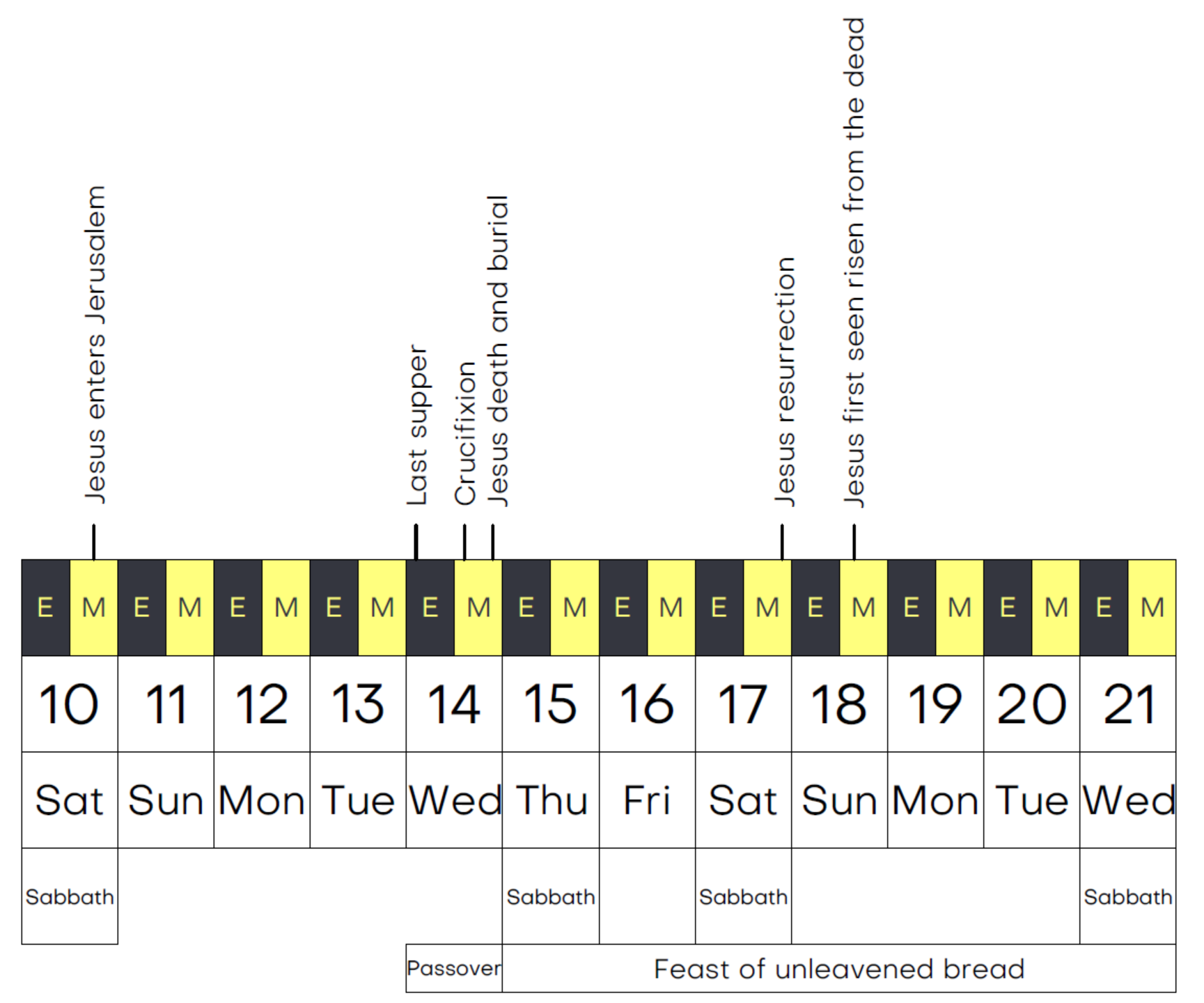
The solution to this conundrum is simple once it is recognised that the day after the Passover, the 15th day of the first month, is the first day of the feast of unleavened bread and an annual Sabbath. It is this day, not the weekly Sabbath (Saturday), that is referred to as the day following the crucifixion:
And now when the even was come, because it was the preparation, that is, the day before the sabbath,
Joseph of Arimathaea, an honourable counsellor, which also waited for the kingdom of God, came, and went in boldly unto Pilate, and craved the body of Jesus. (Mar 15:42-43)
After this annual Sabbath, the women who were faithful to Jesus went shopping for spices to anoint the body. They then rested during the weekly Sabbath and thereafter approached the grave as it began to get light, very early on Sunday morning. They found the grave empty.
And when the sabbath was past, Mary Magdalene, and Mary the mother of James, and Salome, had bought sweet spices, that they might come and anoint him.
And very early in the morning the first day of the week, they came unto the sepulchre at the rising of the sun.
And they said among themselves, Who shall roll us away the stone from the door of the sepulchre?
And when they looked, they saw that the stone was rolled away: for it was very great.
And entering into the sepulchre, they saw a young man sitting on the right side, clothed in a long white garment; and they were affrighted.
And he saith unto them, Be not affrighted: Ye seek Jesus of Nazareth, which was crucified: he is risen; he is not here: behold the place where they laid him. (Mar 16: 1-6)
And in case any should suspect that having two Sabbaths, one a high, holy day (the first day of the feast of unleavened bread) and the second a weekly seventh day, in the same week is an error, it is only necessary to refer to the original Greek of Matthew 28:1):
Now after the Sabbath, toward the dawn of the first day of the week, Mary Magdalene and the other Mary went to see the tomb.
ὀψὲ δὲ σαββάτων τῇ ἐπιφωσκούσῃ εἰς μίαν σαββάτων ἦλθεν Μαριὰμ ἡ Μαγδαληνὴ καὶ ἡ ἄλλη Μαρία θεωρῆσαι τὸν τάφον
The word translated ‘Sabbath’ here is σαββάτων (sabbaton plural), literally ‘Sabbaths’. There were two Sabbaths that week, one on Thursday, the first day of the feast of unleavened bread, and the second on Saturday.
The timeline can therefore be summarised as follows:
The Lamb
Having established the dates and days, and cleared up some common errors, let us move on to the more weighty matters.
When John the Baptist saw Christ approaching, he said:
Behold the Lamb of God, which taketh away the sin of the world. (Jhn 1:29)
And Paul, reflecting on his conversion and upon the transformation of his fellow Christians, added:
For even Christ our Passover is sacrificed for us:
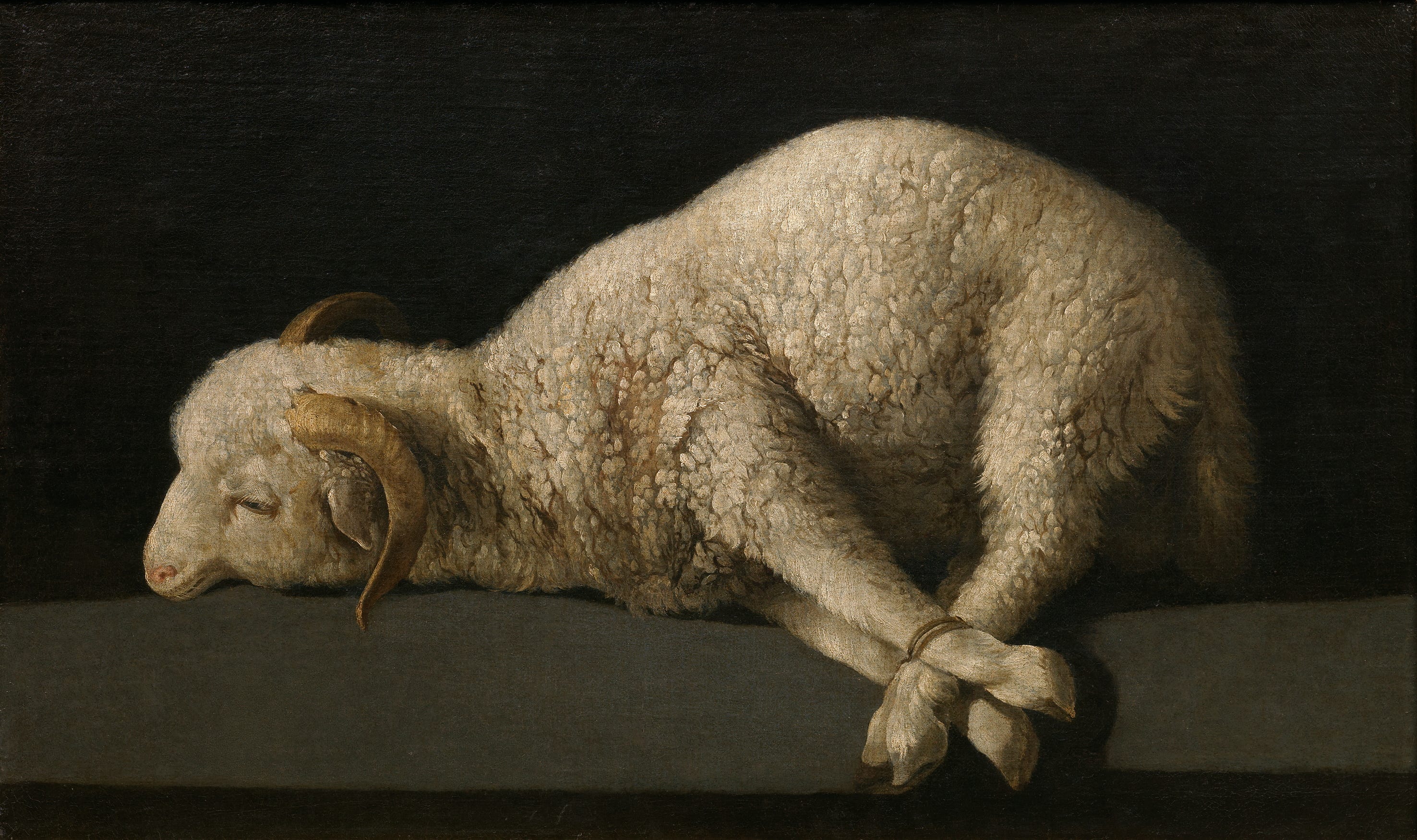
It is therefore clear that the Passover lamb is a metaphor for Christ. Its sacrifice was a foreshadowing of the Son of God’s own, voluntary sacrifice. The parallels are numerous, and the following outlines a few, but by no means all.
The original instructions to the Israelites concerning the Passover began with:
Speak ye unto all the congregation of Israel, saying, In the tenth day of this month they shall take to them every man a lamb, according to the house of their fathers, a lamb for an house:
In the year of the crucifixion, the tenth day fell on a Saturday (Sabbath). This was the day during which Christ entered Jerusalem, riding on a donkey:
And brought the ass, and the colt, and put on them their clothes, and they set him thereon.
And a very great multitude spread their garments in the way; others cut down branches from the trees, and strawed them in the way.
And the multitudes that went before, and that followed, cried, saying, Hosanna to the Son of David: Blessed is he that cometh in the name of the Lord; (Mat 21:7-9)
It is a useful confirmation of the timeline that two days previously, Christ and his disciples arrived at Bethany, around 6 km East of Jerusalem. They had supper with Martha and Lazarus, and presumably stayed the night.
Then Jesus six days before the passover came to Bethany, where Lazarus was which had been dead, whom he raised from the dead.
There they made him a supper; and Martha served: but Lazarus was one of them that sat at the table with him. (Jhn 12:1-2)
The next day, they moved up to the Mount of Olives:
And when they drew nigh unto Jerusalem, and were come to Bethphage, unto the mount of Olives, (Mat 21:1)
This placed them a sabbath day’s journey from Jerusalem, as is confirmed in the book of Acts:
Then returned they unto Jerusalem from the mount called Olivet, which is from Jerusalem a sabbath day's journey.
Thus, the bringing in of the lamb to the houses of the Israelites prefigured Christ’s entry into Jerusalem.
Another symbol embedded in the Passover concerns the lamb used to represent Christ. It was required to be perfect:
Your lamb shall be without blemish, a male of the first year: ye shall take it out from the sheep, or from the goats: (Exo 12:5)
This perfection was a model of Christ’s own spiritual perfection:
He committed no sin, neither was deceit found in his mouth. (1 Pet 2:22)
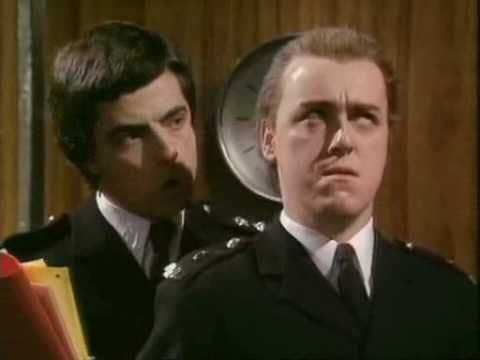
Jesus was without blemish because he did not sin. The lamb was without any physical blemish and is thus an archetype representing Christ. The perfection of Christ posed no end of difficulties to those attempting to condemn and kill him. For example, when the priests brought Jesus to Pilate to have him executed, their attempts to find some charge that would stick bordered on the farcical:
Pilate then went out unto them, and said, What accusation bring ye against this man?
They answered and said unto him, If he were not a malefactor, we would not have delivered him up unto thee. (Jhn 18:29-30)
Surely a statement worthy of Police Constable Savage in the famous comedy sketch:
It got little better for the priests when Pilate examined Christ directly:
Then Pilate entered into the judgment hall again, and called Jesus, and said unto him, Art thou the King of the Jews?
Jesus answered him, Sayest thou this thing of thyself, or did others tell it thee of me?
Pilate answered, Am I a Jew? Thine own nation and the chief priests have delivered thee unto me: what hast thou done?
Jesus answered, My kingdom is not of this world: if my kingdom were of this world, then would my servants fight, that I should not be delivered to the Jews: but now is my kingdom not from hence.
Pilate therefore said unto him, Art thou a king then? Jesus answered, Thou sayest that I am a king. To this end was I born, and for this cause came I into the world, that I should bear witness unto the truth. Every one that is of the truth heareth my voice.
Pilate saith unto him, What is truth? And when he had said this, he went out again unto the Jews, and saith unto them, I find in him no fault at all. (John 18:33-38)
Thus, as the Passover lamb was examined and found to be without blemish, Christ was examined and found to be without fault.
The Last Supper and Gethsemane
At the last supper, Christ created new and enduring symbols in bread and wine:
And as they were eating, Jesus took bread, and blessed it, and brake it, and gave it to the disciples, and said, Take, eat; this is my body.
And he took the cup, and gave thanks, and gave it to them, saying, Drink ye all of it;
For this is my blood of the new testament, which is shed for many for the remission of sins. (Mat 26:26-28)
Later, they proceeded to the garden at Gethsemane. In this Garden, Christ, knowing exactly what was about to befall him, remained obedient and resisted the temptation to flee. Thus, Jesus, the second Adam, remained faithful and true in the garden. This is in stark contrast to the weakness and sin of the first Adam in the Garden of Eden.
The apostles slept, and Christ was alone, apart from an angel sent from heaven to strengthen him.
And while he yet spake, behold a multitude, and he that was called Judas, one of the twelve, went before them, and drew near unto Jesus to kiss him.
But Jesus said unto him, Judas, betrayest thou the Son of man with a kiss?
When they which were about him saw what would follow, they said unto him, Lord, shall we smite with the sword?
And one of them smote the servant of the high priest, and cut off his right ear.
And Jesus answered and said, Suffer ye thus far. And he touched his ear, and healed him.
Then Jesus said unto the chief priests, and captains of the temple, and the elders, which were come to him, Be ye come out, as against a thief, with swords and staves?
When I was daily with you in the temple, ye stretched forth no hands against me: but this is your hour, and the power of darkness. (Luke 22:47-53)
And thus was our Lord betrayed with a kiss and taken by the forces of darkness.
The Blood
The Passover lamb was sacrificed, and its blood protected the people from death:
And ye shall keep it up until the fourteenth day of the same month: and the whole assembly of the congregation of Israel shall kill it in the evening.
And they shall take of the blood, and strike it on the two side posts and on the upper door post of the houses, wherein they shall eat it.
And they shall eat the flesh in that night, roast with fire, and unleavened bread; and with bitter herbs they shall eat it….
For I will pass through the land of Egypt this night, and will smite all the firstborn in the land of Egypt, both man and beast; and against all the gods of Egypt I will execute judgment: I am the LORD.
And the blood shall be to you for a token upon the houses where ye are: and when I see the blood, I will pass over you, and the plague shall not be upon you to destroy you, when I smite the land of Egypt. (Exo 12:6-8, 12-13)
What is noticeable here is that the blood of the Lamb alone is sufficient protection; no other conditions are applied. The previous conduct of the inhabitants of the houses is irrelevant. Their status, wealth, sex, or any other feature often considered important by man, plays no part in saving them from death. Those males eating the passover were to be only those who were circumcised, but ethnicity per se was also irrelevant. Likewise, the blood of Jesus, our lamb, offers us eternal life irrespective of our background, previous sins, status, wealth or nationality.
They painted the blood on their doorposts and lintels, an act that would appear crazy to many, but which places an outward symbol where it can be seen. This too resonates as to follow Christ is often to be seen as foolish by those with a materialistic worldview:
But we preach Christ crucified, unto the Jews a stumblingblock, and unto the Greeks foolishness (1 Cor 1:23)
Another example of the Passover sacrifice prefiguring Christ is that the lamb was not to have any bones broken:
They shall leave none of it unto the morning, nor break any bone of it: according to all the ordinances of the passover they shall keep it. (Num 9:12)
This was fulfilled also by Christ, as is recorded in the Gospel of John:
The Jews therefore, because it was the preparation, that the bodies should not remain upon the cross on the sabbath day, (for that sabbath day was an high day,) besought Pilate that their legs might be broken, and that they might be taken away.
Then came the soldiers, and brake the legs of the first, and of the other which was crucified with him.
But when they came to Jesus, and saw that he was dead already, they brake not his legs: (John 19:31-33)
Furthermore, Christ was silent during much of his questioning and trial:
And the chief priests accused him of many things: but he answered nothing.
And Pilate asked him again, saying, Answerest thou nothing? behold how many things they witness against thee.
But Jesus yet answered nothing; so that Pilate marvelled. (Mar 15:3-5)
This was as prophesied by Isaiah:
He was oppressed, and he was afflicted, yet he opened not his mouth: he is brought as a lamb to the slaughter, and as a sheep before her shearers is dumb, so he openeth not his mouth. (Isa 53:7)
Therefore, Christ fulfilled, in detail, the symbology of the Passover. He is the Lamb of God who bled and died for us, that we might be freed from death, the wages of sin.
Psalm 22
And at the ninth hour Jesus cried with a loud voice, saying, Eloi, Eloi, lama sabachthani? which is, being interpreted, My God, my God, why hast thou forsaken me? (Mar 15:34)
In this, he was quoting from the twenty-second Psalm. This was a description of Christ’s suffering written 1000 years earlier. It starts:
My God, my God, why hast thou forsaken me? why art thou so far from helping me (verse 1)
and continues:
But I am a worm, and no man; a reproach of men, and despised of the people.
All they that see me laugh me to scorn: they shoot out the lip, they shake the head, saying,
He trusted on the LORD that he would deliver him: let him deliver him, seeing he delighted in him. Psa 22:6-8)
This accurately recounts the mocking response of the mob to Jesus’ suffering. The Psalm proceeds to describe the pain and torment of the crucifixion:
I am poured out like water, and all my bones are out of joint: my heart is like wax; it is melted in the midst of my bowels.
My strength is dried up like a potsherd; and my tongue cleaveth to my jaws; and thou hast brought me into the dust of death.
For dogs have compassed me: the assembly of the wicked have inclosed me: they pierced my hands and my feet.
I may tell all my bones: they look and stare upon me.
They part my garments among them, and cast lots upon my vesture.
But be not thou far from me, O LORD: O my strength, haste thee to help me. (Psa22: 14-19)
When this Psalm says “they have pierced my hands and feet”, it predicted the cruel crucifixion method of capital punishment hundreds of years before it had been invented. When it says they will cast lots upon my vesture (clothing), the Psalm predicts what the soldiers who crucified Jesus would cast lots to see who would keep his tunic.
The Psalm also says “haste to help me”. The Lord God Almighty did just that by ending Jesus’ suffering just after he quoted the first line.
And finally, the psalmist then speaks of the Kingdom of God, which Christ preached during his earthly ministry and that we will rule:
All the ends of the world shall remember and turn unto the LORD: and all the kindreds of the nations shall worship before thee.
For the kingdom is the LORD’S: and he is the governor among the nations. (Psa 22:27-28)
Thus, with his final breath, he continued to declare the coming Kingdom and his rule over all of the nations.
What it all means
In God not withholding his only son that he loved, and in Christ’s voluntary sacrifice of his spotless life, profound changes occurred, and Christ achieved a spiritual victory over evil of such magnitude as to almost defy description:
But made himself of no reputation, and took upon him the form of a servant, and was made in the likeness of men:
And being found in fashion as a man, he humbled himself, and became obedient unto death, even the death of the cross.
Wherefore God also hath highly exalted him, and given him a name which is above every name:
That at the name of Jesus every knee should bow, of things in heaven, and things in earth, and things under the earth;
And that every tongue should confess that Jesus Christ is Lord, to the glory of God the Father. (Phl 2:7-11)
The things achieved included the forgiveness of sins. As the wages of sin are death, all of fallen humanity was under sentence of death. There was no human way out of this. There is now:
Who hath delivered us from the power of darkness, and hath translated us into the kingdom of his dear Son:
In whom we have redemption through his blood, even the forgiveness of sins: (Col 1:13-14)
And with sins being forgiven, we have the prospect of resurrection to life:
Therefore as by the offence of one judgment came upon all men to condemnation; even so by the righteousness of one the free gift came upon all men unto justification of life. (Rom 5:18)
For each of us today, Christ offers new spiritual life; a change; a transformation; a renewal.
Therefore if any man be in Christ, he is a new creature: old things are passed away; behold, all things are become new.
For he hath made him to be sin for us, who knew no sin; that we might be made the righteousness of God in him. (2 Col 5:17,21)
Since the failure of the first Adam, mankind had been shut away from direct contact with God. Instead, contact was through rituals, a priesthood and the temple. The people as a whole could only enter the outer court. They were far from God’s presence. The place where God resided, the Holy of Holies, could only be entered by the High Priest on one day per year, the Day of Atonement (Yom Kippur). The inner holy court of the temple, where the priests served daily, was separated from the Holy of Holies by a thick, intricately woven curtain called the veil. This symbolised the barrier between God and a sinful humanity.
When Christ died, this veil was torn in two:
And, behold, the veil of the temple was rent in twain from the top to the bottom; and the earth did quake, and the rocks rent; (Mat 27:51)
And the veil of the temple was rent in twain from the top to the bottom. (Mar 15:38)
And the sun was darkened, and the veil of the temple was rent in the midst. (Luk 23:45)
This sign shows that the barrier between God and man had been likewise riven.
His victory furthermore placed Christ in a position of great authority, having overcome sin and death and defeated Satan and evil. This is reflected in how he is described later in the prophetic timeline:
And I beheld, and I heard the voice of many angels round about the throne and the beasts and the elders: and the number of them was ten thousand times ten thousand, and thousands of thousands;
Saying with a loud voice, Worthy is the Lamb that was slain to receive power, and riches, and wisdom, and strength, and honour, and glory, and blessing. (Rev 5:11-12)
Concluding remarks
The Passover represents the sacrifice of Christ, the Lamb of God, so that we may receive not death (the wages of our sins) but instead new life. Speaking of the personal transformation he had experienced, Paul said:
I am crucified with Christ: nevertheless I live; yet not I, but Christ liveth in me: and the life which I now live in the flesh I live by the faith of the Son of God, who loved me, and gave himself for me. (Gal 2:20)
Christ’s sacrifice offers access to truth and to transformative change:
I am come a light into the world, that whosoever believeth on me should not abide in darkness. (John 12:46)
And this change will ultimately mean life itself replacing the grave:
For God so loved the world, that he gave his only begotten Son, that whosoever believeth in him should not perish, but have everlasting life. (Jhn 3:16)
And in overcoming evil and defeating death, Christ our Lamb has become more mighty than evil can ever resist. His victory, gained on the cross, is assured. Further victories lie ahead:
These shall make war with the Lamb, and the Lamb shall overcome them: for he is Lord of lords, and King of kings: and they that are with him are called, and chosen, and faithful. (Rev 17:14)
This mighty work is the first step in God’s plan for the redemption of mankind. In the next article, we shall examine the closely related Feast of Unleavened Bread.
Excellent article!
Thank you David for 'The Passover'. You have said it all and re-awakened my belief in and love of Jesus and all he stands for, especially in these dark times. It is indeed as you say 'More gold than we can possibly mine'
Look after yourself
Love Gem xxx