
11 Tabernacles
Christ's millennial rule

The Feast of Tabernacles or Sukkot, is named for the temporary dwelling that the Israelites are instructed to live in for one week. God gave this instruction to Israel in the wilderness after they had left Egypt:
And the LORD spake unto Moses, saying,
Speak unto the children of Israel, saying, The fifteenth day of this seventh month shall be the feast of tabernacles for seven days unto the LORD.
On the first day shall be an holy convocation: ye shall do no servile work therein.
Seven days ye shall offer an offering made by fire unto the LORD: on the eighth day shall be an holy convocation unto you; and ye shall offer an offering made by fire unto the LORD: it is a solemn assembly; and ye shall do no servile work therein. (Lev 23:33-36)
The feast lasts seven days. Like the other long feast, the Feast of Unleavened Bread, the seven days overlap into an eighth day. In this case, the eighth day is called ‘The Last Great Day’ (John 7:37), and it follows immediately after Tabernacles. That will be the subject of the penultimate article in this series.
The first of the seven days is an annual Sabbath, signifying a role for mankind to play in God’s great plan.
Later in the 23rd chapter of Leviticus, the instruction to keep this feast is repeated, and further details are added:
Also in the fifteenth day of the seventh month, when ye have gathered in the fruit of the land, ye shall keep a feast unto the LORD seven days: on the first day shall be a sabbath, and on the eighth day shall be a sabbath.
And ye shall take you on the first day the boughs of goodly trees, branches of palm trees, and the boughs of thick trees, and willows of the brook; and ye shall rejoice before the LORD your God seven days.
And ye shall keep it a feast unto the LORD seven days in the year. It shall be a statute for ever in your generations: ye shall celebrate it in the seventh month.
Ye shall dwell in booths seven days; all that are Israelites born shall dwell in booths:
That your generations may know that I made the children of Israel to dwell in booths, when I brought them out of the land of Egypt: I am the LORD your God. (Lev 23:39-43)
We see that this statute will apply forever (more on that in a moment), and that it is a time of rejoicing and happiness. The historical context is that Israel dwelt in temporary booths in the wilderness after leaving Egypt. We have already seen that Egypt is a metaphor for sin. Furthermore, the previous holy day (the Day of Atonement) symbolises Israel and Judah reuniting and repenting of their sins, becoming, at last, God’s people. It is thus entirely consistent that this is a time of happiness and joy, representing God’s rule over a harmonious, spirit-filled nation that has cast off and repented of its previous sinful ways.

The instruction regarding the seven-day-long Tabernacles feast is repeated in the book of Deuteronomy, and it is one of the three festivals that are to be kept, whenever possible, in Jerusalem, the place selected by God:
Thou shalt observe the feast of tabernacles seven days, after that thou hast gathered in thy corn and thy wine:
And thou shalt rejoice in thy feast, thou, and thy son, and thy daughter, and thy manservant, and thy maidservant, and the Levite, the stranger, and the fatherless, and the widow, that are within thy gates.
Seven days shalt thou keep a solemn feast unto the LORD thy God in the place which the LORD shall choose: because the LORD thy God shall bless thee in all thine increase, and in all the works of thine hands, therefore thou shalt surely rejoice.
Three times in a year shall all thy males appear before the LORD thy God in the place which he shall choose; in the feast of unleavened bread, and in the feast of weeks, and in the feast of tabernacles: and they shall not appear before the LORD empty:
Every man shall give as he is able, according to the blessing of the LORD thy God which he hath given thee. (Deut 16:13-17)
Here we see that ‘the stranger within thy gates’ is also to keep the feast. This is a consistent principle in the word of God: it is to Israel first and then also to the other nations as they are reconciled to the Lord.
Christ’s dominion
Christ’s kingship was predicted before his conception in human form:
And the angel said unto her, Fear not, Mary: for thou hast found favour with God.
And, behold, thou shalt conceive in thy womb, and bring forth a son, and shalt call his name JESUS.
He shall be great, and shall be called the Son of the Highest: and the Lord God shall give unto him the throne of his father David:
And he shall reign over the house of Jacob for ever; and of his kingdom there shall be no end. (Luke 1:30-33)
And his kingship does not stop with the House of Jacob. Rather, it extends over the whole earth and over every nation. Furthermore, it is a rule without the need for military force, having both great humility and tremendous power and authority:
Rejoice greatly, O daughter of Zion; shout, O daughter of Jerusalem: behold, thy King cometh unto thee: he is just, and having salvation; lowly, and riding upon an ass, and upon a colt the foal of an ass.
And I will cut off the chariot from Ephraim, and the horse from Jerusalem, and the battle bow shall be cut off: and he shall speak peace unto the heathen: and his dominion shall be from sea even to sea, and from the river even to the ends of the earth. (Zec 9:9-10)
Hence, we see that Christ’s rule is global in extent and that it will bring peace on earth. He will be physically in Jerusalem, and his rule is not merely one of honest and wise administration. It brings salvation, forgiveness, repentance, and the spirit of God to change the hearts of men.
The prophet Isaiah also foresaw Christ’s government:
For unto us a child is born, unto us a son is given: and the government shall be upon his shoulder: and his name shall be called Wonderful, Counsellor, The mighty God, The everlasting Father, The Prince of Peace.
Of the increase of his government and peace there shall be no end, upon the throne of David, and upon his kingdom, to order it, and to establish it with judgment and with justice from henceforth even for ever. The zeal of the LORD of hosts will perform this. (Isa 9:6-7)
And it is this government, this rule on earth by Christ, the Son of God, who is without sin, but who understands human woes and temptations, weaknesses and sorrows, that is symbolised by the seven-day-long Tabernacles Feast.
Satan bound
The devil, Satan, is called the prince of the power of the air:
Wherein in time past ye walked according to the course of this world, according to the prince of the power of the air, the spirit that now worketh in the children of disobedience: (Eph 2:2)
This indicates the diffuse, unseen nature of the influence he wields over mankind. By imparting a spirit of rebellion and disobedience, Satan generates conflict and sin, suffering and cruelty. His influence is to be entirely removed for one thousand years:
And I saw an angel come down from heaven, having the key of the bottomless pit and a great chain in his hand.
And he laid hold on the dragon, that old serpent, which is the Devil, and Satan, and bound him a thousand years,
And cast him into the bottomless pit, and shut him up, and set a seal upon him, that he should deceive the nations no more, till the thousand years should be fulfilled: and after that he must be loosed a little season. (Rev 20:1-3)
Absent Satan’s influence, with the resurrected Saints ruling with Christ from Jerusalem, and with the example of God’s restored nation, Israel, showing the way, the nations will turn to God. Peace will be established on the earth.
A thousand-year reign
Christ’s rule and Satan’s removal from human affairs are to last for a thousand years:
Blessed and holy is he that hath part in the first resurrection: on such the second death hath no power, but they shall be priests of God and of Christ, and shall reign with him a thousand years. (Rev 20:6)
It is no surprise that anti-Christ candidate, Adolf Hitler, selected this same span for his counterfeit kingdom, the "Thousand-Year Reich".
And what will be the nature of that reign? It is foretold in the prophetic writings of Isaiah:
The word that Isaiah the son of Amoz saw concerning Judah and Jerusalem.
And it shall come to pass in the last days, that the mountain of the LORD’S house shall be established in the top of the mountains, and shall be exalted above the hills; and all nations shall flow unto it.
And many people shall go and say, Come ye, and let us go up to the mountain of the LORD, to the house of the God of Jacob; and he will teach us of his ways, and we will walk in his paths: for out of Zion shall go forth the law, and the word of the LORD from Jerusalem.
And he shall judge among the nations, and shall rebuke many people: and they shall beat their swords into plowshares, and their spears into pruninghooks: nation shall not lift up sword against nation, neither shall they learn war any more. (Isa 2:1-4)
This shows that mountains and hills are biblical symbols for nations and kingdoms, and that the various nations shall remain separate, but that the Kingdom of God (Christ and his resurrected saints) will rule over them all. We can also see that the nations of the earth will go to Jerusalem to seek God and to learn his ways. They will do so voluntarily, seeking knowledge of God and understanding of his law.
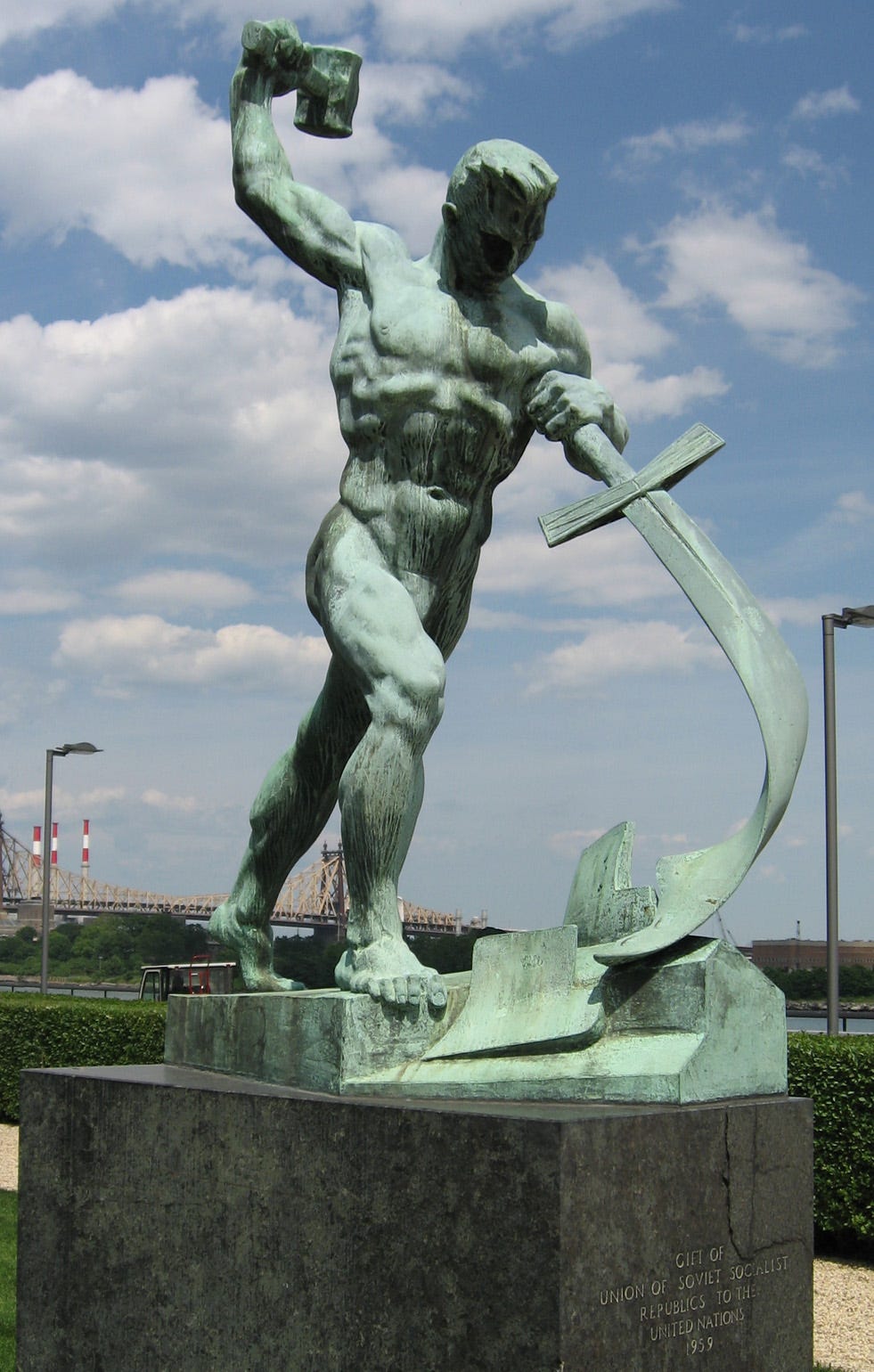
We can also see that war will be no more, that Christ shall judge disputes between peoples, making armies and means of mass killing entirely redundant. In a high point of recycling, weapons will be remade into implements of agriculture, bringing life, not death. This powerful metaphor was purloined by the United Nations, which, like Adolf Hitler, sought to lay claim to God’s Kingdom. They placed a statue of a man beating a sword to form a plough outside their New York headquarters. This was a gift from the murderous, oppressive, very heavily armed and not infrequently hungry people of the Soviet Union:
The earth under Christ’s wise rule
Under Christ’s rule, and the spiritual transformation that accompanies it, much of the harm that was done to the wider creation by the human rebellion in Eden will be reversed. This is illustrated in the book of Isaiah, which predicts changes to the animal kingdom as aggressiveness and predation are replaced by coexistence and safety:
The wolf also shall dwell with the lamb, and the leopard shall lie down with the kid; and the calf and the young lion and the fatling together; and a little child shall lead them.
And the cow and the bear shall feed; their young ones shall lie down together: and the lion shall eat straw like the ox.
And the sucking child shall play on the hole of the asp, and the weaned child shall put his hand on the cockatrice’ den.
They shall not hurt nor destroy in all my holy mountain: for the earth shall be full of the knowledge of the LORD, as the waters cover the sea.
And in that day there shall be a root of Jesse, which shall stand for an ensign of the people; to it shall the Gentiles seek: and his rest shall be glorious. (Isa 11:6-10)
The prophet Micah also describes the peace in human affairs:
But in the last days it shall come to pass, that the mountain of the house of the LORD shall be established in the top of the mountains, and it shall be exalted above the hills; and people shall flow unto it.
And many nations shall come, and say, Come, and let us go up to the mountain of the LORD, and to the house of the God of Jacob; and he will teach us of his ways, and we will walk in his paths: for the law shall go forth of Zion, and the word of the LORD from Jerusalem.
And he shall judge among many people, and rebuke strong nations afar off; and they shall beat their swords into plowshares, and their spears into pruninghooks: nation shall not lift up a sword against nation, neither shall they learn war any more. (Mic 4:1-3)
Micah continues to show economic well-being deriving from God’s rule. The result is sufficient resources for human thriving without excessive labour. Once the present systems of human predation (called taxation, theft, and envy) are replaced by laws of justice and generosity, life will have more abundance. Furthermore, there will be time to enjoy it:
But they shall sit every man under his vine and under his fig tree; and none shall make them afraid: for the mouth of the LORD of hosts hath spoken it.
For all people will walk every one in the name of his god, and we will walk in the name of the LORD our God for ever and ever. (Mic 4:4-5)
In this national and international walk with God, the people will find that they no longer have fear of losing everything due to theft, injustice or misfortune. Neither must they work every hour to pay interest on loans or rent for land their fathers bought before them. Without exploitation and expropriation, a man will instead have time to sit under his fig tree and enjoy being alive.
All nations to keep the feast
This feast is not only intended for Israel. Rather, as with all things pertaining to the redemption of mankind, it starts with Israel and then extends to all of the nations. This is made explicit in the book of Zechariah:
And it shall come to pass, that every one that is left of all the nations which came against Jerusalem shall even go up from year to year to worship the King, the LORD of hosts, and to keep the feast of tabernacles.
And it shall be, that whoso will not come up of all the families of the earth unto Jerusalem to worship the King, the LORD of hosts, even upon them shall be no rain.
And if the family of Egypt go not up, and come not, that have no rain; there shall be the plague, wherewith the LORD will smite the heathen that come not up to keep the feast of tabernacles.
This shall be the punishment of Egypt, and the punishment of all nations that come not up to keep the feast of tabernacles. (Zec14:16-19)
This illustrates, without a doubt, that the system of Sabbaths, weekly days of rest and seven annual Sabbaths, is fully in effect during Christ’s rule on earth. As a consequence, we must conclude that these Sabbaths are current now and should be observed by Christians. In fact, only a tiny minority of Christians observe them, and most evangelical pastors would characterise observance of God’s holy days as Judaising Christianity, or legalism or redemption by works, and consequently condemn the practice roundly. This is a strange position given the clarity in scripture on these points and the example given by Christ and the apostles. By shutting their eyes and closing their ears to so much of scripture, many insights are sadly lost.
Reflection in the Psalms
The beauty and peace of God’s rule are also described in the psalms, for example, in Psalm 2:
Why do the heathen rage, and the people imagine a vain thing?
The kings of the earth set themselves, and the rulers take counsel together, against the LORD, and against his anointed, saying,
Let us break their bands asunder, and cast away their cords from us.
He that sitteth in the heavens shall laugh: the Lord shall have them in derision.
Then shall he speak unto them in his wrath, and vex them in his sore displeasure.
Yet have I set my king upon my holy hill of Zion.
I will declare the decree: the LORD hath said unto me, Thou art my Son; this day have I begotten thee.
Ask of me, and I shall give thee the heathen for thine inheritance, and the uttermost parts of the earth for thy possession.
Thou shalt break them with a rod of iron; thou shalt dash them in pieces like a potter’s vessel.
Be wise now therefore, O ye kings: be instructed, ye judges of the earth.
Serve the LORD with fear, and rejoice with trembling.
Kiss the Son, lest he be angry, and ye perish from the way, when his wrath is kindled but a little. Blessed are all they that put their trust in him. (Psalm 2:1-12)
We see in this the opposition, plotting and scheming faced by Christ at his return, but his victory and authority are certain. So much so that God laughs at the attempts by human rulers to subvert his plans.
Also, Psalm 72 speaks of Christ’s just rule and the justice he brings to overthrow the oppressors. Having observed the lack of justice in our corrupt and deceitful legal systems, I look forward to the day when the poor and needy receive justice, and the powerful oppressors can no longer use legal means to silence their victims.
Give the king thy judgments, O God, and thy righteousness unto the king’s son.
He shall judge thy people with righteousness, and thy poor with judgment.
The mountains shall bring peace to the people, and the little hills, by righteousness.
He shall judge the poor of the people, he shall save the children of the needy, and shall break in pieces the oppressor. (Psa 72:1-4)
This is repeated later in the Psalms in the context of Christ’s global rule:
Yea, all kings shall fall down before him: all nations shall serve him.
For he shall deliver the needy when he crieth; the poor also, and him that hath no helper.
He shall spare the poor and needy, and shall save the souls of the needy.
He shall redeem their soul from deceit and violence: and precious shall their blood be in his sight. (Psa 72:11-14)
Christ’s rule brings justice, as well as peace and plenty.
Christ keeps the feast
So what happened during Christ’s ministry when the Feast of Tabernacles was being observed? John’s gospel records:
After these things Jesus walked in Galilee: for he would not walk in Jewry, because the Jews sought to kill him.
Now the Jews’ feast of tabernacles was at hand.
His brethren therefore said unto him, Depart hence, and go into Judaea, that thy disciples also may see the works that thou doest.
For there is no man that doeth any thing in secret, and he himself seeketh to be known openly. If thou do these things, shew thyself to the world.
For neither did his brethren believe in him.
Then Jesus said unto them, My time is not yet come: but your time is alway ready.
The world cannot hate you; but me it hateth, because I testify of it, that the works thereof are evil.
Go ye up unto this feast: I go not up yet unto this feast; for my time is not yet full come.
When he had said these words unto them, he abode still in Galilee.
But when his brethren were gone up, then went he also up unto the feast, not openly, but as it were in secret. (John 7:1-10)
It is plain that, first, Christ sent his disciples to keep the feast, and then, despite the severe and immediate threat to his life, he disguised himself and also went up to Jerusalem to keep the Feast of Tabernacles.
Moreover, once he had avoided the Jews who were seeking to kill him, he then went into the temple and preached openly!
Then the Jews sought him at the feast, and said, Where is he?
And there was much murmuring among the people concerning him: for some said, He is a good man: others said, Nay; but he deceiveth the people.
Howbeit no man spake openly of him for fear of the Jews.
Now about the midst of the feast Jesus went up into the temple, and taught.
And the Jews marvelled, saying, How knoweth this man letters, having never learned? (John 7:11-15)
The line of attack the Jews used with Christ was, not for the only time, the Sabbath. Christ was doing God’s work in God’s holy time. The Jews objected, and Christ showed their hypocrisy and inconsistency in his retort:
Jesus answered and said unto them, I have done one work, and ye all marvel.
Moses therefore gave unto you circumcision; (not because it is of Moses, but of the fathers;) and ye on the sabbath day circumcise a man.
If a man on the sabbath day receive circumcision, that the law of Moses should not be broken; are ye angry at me, because I have made a man every whit whole on the sabbath day? (John 7:21-23)
Moreover, his gallantry and lack of fear in the face of murderous plots against his life inspired the very reaction the plotters most feared:
Then said some of them of Jerusalem, Is not this he, whom they seek to kill?
But, lo, he speaketh boldly, and they say nothing unto him. Do the rulers know indeed that this is the very Christ?
And many of the people believed on him, and said, When Christ cometh, will he do more miracles than these which this man hath done? (John 7:25-26, 31)
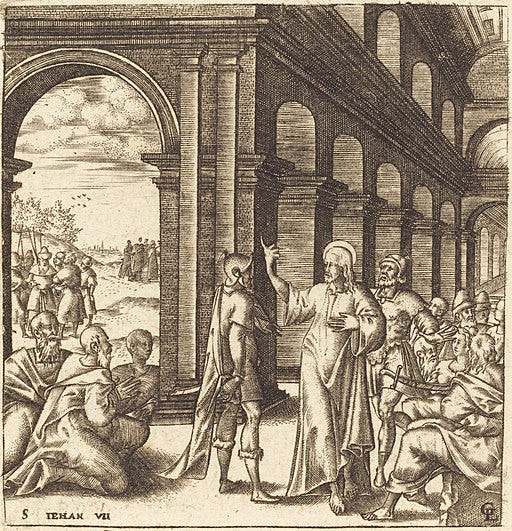
Thus, during Tabernacles, Christ went to Jerusalem, kept the feast, and preached the Gospel of the Kingdom, despite the dangers that were involved.
Closing remarks
The Feast of Tabernacles represents the time when Christ will dwell with man on earth and rule as King of Kings. His rule shall be just and will bring peace to the nations of men and harmony to the natural world. There will be abundance and justice. Fear will cease to be the principal tool of government; instead being replaced by righteousness.
His rule will extend over the whole earth and over all of the nations. Truly, it is as David the psalmist said:
Blessed be the LORD God, the God of Israel, who only doeth wondrous things.
And blessed be his glorious name for ever: and let the whole earth be filled with his glory; Amen, and Amen.(Psa 72:18-19)
Thanks David, and what a goal to look forward to, to be some part of helping bring the plan to fruition.
Hi David.
I love your work. It is thoughtful and considered, and clearly evidences a man on a spiritual biblical journey.
It is a path we are all on, even the most adamant atheists, who don't realised that they have closed the biblical door, and have stopped searching, and all the while, Jesus is knocking.
Becoming fixed in a creed is the Protestant way: most often Formal Churches have become fixated and strayed from Sola Scriptura - hence why they are all different.
The 'fire-refining' process never ends, yet we allow it to.
To counter this we must look to the Bible for Truth, so please see comments below in that light: this is a discussion on your piece with verses that offer a different perspective to yours, which are hopefully worthy of consideration, offered as Questions:
Q1: Should we still follow all the Feasts today?
Your piece suggests that we should be following the Feast cycle - the High Day - Holy Convocation Sabbaths.
By that argument are you also suggesting we follow new moon Sabbaths as well, etc, and do you separate them all from the 7th Day Sabbath (and keep that), which was instituted as one of the 10 Commandment Moral Laws at the end of the creation week, rather than all the Mosaic Ceremonial law sabbaths?
Paul is clear that the Temple Feast process was 'nailed to the cross', hence why the Temple Veil ripped from Top to Bottom: God was telling us that the sacrificial feast process had been replaced by His Son's "once only" sacrifice (as Hebrews describes).
Here is Paul in
Colossians 2:16-17 KJV, with which you will be familiar:
"[16] Let no man therefore judge you in meat, or in drink, or in respect of an holyday, or of the new moon, or of the sabbath days:
[17] which are a shadow of things to come; but the body is of Christ." Note he isn't including God's 7th Day Sabbath, which he continued to keep, as did Jesus, and the Apostles, obviously: which was only replaced by Sun(god)day-worship when Constantine 'syncretised' pagan sun-worship with Apostolic Christianity, and the Vatican Antichrist enforced it (along with 'trinity').
Clearly the Feasts have prophetic meaning, which I think is one of your main points: with the Fall Feasts symbolising Christ's 2nd Advent (and actually His 3rd, for the Last Great Day, see below). This is the most important rationale for understanding the feast structure: they are Types to Christ's AntiType, Shadow to His Substance.
It begs the subsidiary Q: have you been circumcised? Paul points out that the 'Gentile uncircumcised' do not follow the Feasts - that process was for the Jews, if they wanted to continue (which he noted wasn't required). And the Council at Jerusalem, under James, agreed with him.
When we read their discussions on "circumcision" the entire issue includes "keeping feasts" - so if you are keeping the Feast Days, have you also been circumcised...? [The debate in Acts starts here as you will know: Acts 15:5 KJV
"[5] But there rose up certain of the sect of the Pharisees which believed, saying, That it was needful to circumcise them, and to command them to keep the law of Moses."
Clearly they confirmed Gentiles didn't, and wrote a letter to everyone.
Finally Paul points out in Romans 2 that being "circumcised under the Law" did the Jews no good anyway - in other words keeping all their Feasts as 'Phariseic circumcised self-righteous jews' got them nowhere: he elswhere explains that "Righteousness by Faith" is the key: which starts with obedience to God's Moral Laws as a "natural lived experience prerequisite", but grounded in the 10 Commandments 'character of God, the Christian strives towards the perfection of Christ through His Righteousness not our own "Ceremonial Law" keeping, which system failed the 'Phariseic jews':
Romans 2:12 KJV
"[12] For as many as have sinned without law shall also perish without law: and as many as have sinned in the law shall be judged by the law;"
Note I am carefully differentiating between the Mosaic Ceremonial law on paper next to the Ark - nailed to the cross, and God's eternal Moral Law: the 10 Commandments, written on 'permanent stone', inside the Ark: there is a difference.
I've written about them here:
Remember the Sabbath:
https://t.me/dommoor/34271
"I am the LORD thy God":
https://t.me/dommoor/30110
Q2: Where is the Bottomless Pit?
You quote Rev 20:1-3, but don't firmly establish where that Bottomless Pit is, assuming it is not Earth:
"And cast him into the bottomless pit, and shut him up, and set a seal upon him, that he should deceive the nations no more, till the thousand years should be fulfilled: and after that he must be loosed a little season."
Yet the bible tells us that the Bottomless Pit is Earth, ergo that the 1000 year 'millennial period' is not on earth but instead in New Jerusalem in heaven:
Here is White on the subject, from "The Great Controversy":
"The revelator foretells the banishment of Satan and the condition of chaos and desolation to which the earth is to be reduced, and he declares that this condition will exist for a thousand years. After presenting the scenes of the Lord's second coming and the destruction of the wicked, the prophecy continues: "I saw an angel come down from heaven, having the key of the bottomless pit and a great chain in his hand. And he laid hold on the dragon, that old serpent, which is the devil, and Satan, and bound him a thousand years, and cast him into the bottomless pit, and shut him up, and set a seal upon him, that he should deceive the nations no more, till the thousand years should be fulfilled: and after that he must be loosed a little season." Revelation 20:1 -3.
That the expression "bottomless pit" represents the earth in a state of confusion and darkness is evident from other scriptures. Concerning the condition of the earth "in the beginning," the Bible record says that it "was without form, and void; and darkness was upon the face of the deep." [THE HEBREW WORD HERE TRANSLATED "DEEP" IS RENDERED IN THE SEPTUAGINT (GREEK) TRANSLATION OF THE HEBREW OLD TESTAMENT BY THE SAME WORD RENDERED "BOTTOMLESS PIT" IN REVELATION 20:1-3.]
Genesis 1:2. Prophecy teaches that it will be brought back, partially at least, to this condition. Looking forward to the great day of God, the prophet Jeremiah declares: "I beheld the earth, and, lo, it was without form, and void; and the heavens, and they had no light. I beheld the mountains, and, lo, they trembled, and all the hills moved lightly. I beheld, and, lo, there was no man, and all the birds of the heavens were fled. I beheld, and, lo, the fruitful place was a wilderness, and all the cities thereof were broken down." Jeremiah 4:23-26.
Here is to be the home of Satan with his evil angels for a thousand years. Limited to the earth, he will not have access to other worlds to tempt and annoy those who have never fallen. It is in this sense that he is bound: there are none remaining, upon whom he can exercise his power. He is wholly cut off from the work of deception and ruin which for so many centuries has been his sole delight..."
[https://archive.org/details/TheGreatControversy/page/n364/mode/1up p659].